

- Email info@ChamundaSwamiJi.com
- Call +1-516-933-7590
-
 Email
info@ChamundaSwamiJi.com
Email
info@ChamundaSwamiJi.com
-
 Call
+1-516-933-7590
Call
+1-516-933-7590


Book an Appointment
Informative
The Spiritual Significance of Tulasi Vivaha
Have you ever wondered why we celebrate Tulasi Vivaha with so much devotion? Why a plant, a mere Tulasi, becomes the bride of Lord Vishnu or Krishna in ritual? The answer lies deep in mythology, dharma, and the subtle lessons of devotion, chastity, and cosmic balance.
Tulasi Vivaha is not just a ritual. It is a story that teaches us about faith, virtue, and the interplay of karma and maya. To understand it, we must first meet the key figures: Vrinda and Jalandhar.
Who Was Vrinda? The Epitome of Chastity
Vrinda was a devotee of Lord Vishnu and the embodiment of purity. Her mind, heart, and body were devoted to her husband, Jalandhar, and her dharma as a wife. But she was more than just a mortal. She was a sadhvi of immense spiritual power.
Her chastity was her strength. Through her unwavering devotion, she protected her husband from all harm, including the attacks of the gods themselves. It is said that no weapon could touch Jalandhar as long as Vrinda’s chastity remained intact. This is a powerful lesson: the spiritual power of virtue, tapasya, and faith can alter the course of destiny.
Think about it. How often do we underestimate the subtle power of dedication? Vrinda’s devotion is a reminder that inner virtue can influence outer reality.
Jalandhar: The Powerful Asura
Jalandhar was no ordinary king or mortal. He was an asura, a demon, but one with extraordinary strength. He was ambitious, powerful, and daring. Through rigorous austerities, he gained immense boons from Lord Shiva, making him almost invincible.
But there was a condition he could not surpass: his invincibility depended entirely on Vrinda’s chastity. Her purity shielded him. Without it, he would be vulnerable, no matter how strong he appeared.
Here’s an insight: strength alone is never enough. Power without virtue can crumble. Jalandhar’s story teaches us that spiritual alignment is the true foundation of success.
The Cosmic Conflict: Gods Versus Jalandhar
Jalandhar’s growing power became a threat even to the devas. They could not defeat him through conventional warfare. Every weapon failed. Every battle was futile. The secret? Vrinda’s unwavering chastity protected him.
This is where the story becomes intricate. Vishnu, the preserver of dharma, needed to intervene. But here’s the delicate part: to defeat Jalandhar and restore cosmic order, he had to find a way to circumvent Vrinda’s protective power without harming her devotion.
Vishnu’s solution was subtle and profound. He assumed the form of Jalandhar and approached Vrinda. Believing her husband had returned, Vrinda welcomed him with devotion. In that moment, her protective power was unknowingly compromised. Jalandhar was defeated, and dharma was restored.
Vrinda’s Transformation: From Mortal to Tulasi
Vrinda’s heartbreak and realization were immense. She had been deceived, yet her devotion remained pure. Lord Vishnu, moved by her virtue and devotion, transformed her into the sacred Tulasi plant. From that moment, she became eternal, revered, and worshipped across all homes.
Through this transformation, the story teaches us resilience in devotion, the power of surrender, and the subtle interplay of karma. Even when life deceives us, devotion and dharma can elevate the soul to immortality.
Tulasi Vivaha Mantra And Puja Steps:
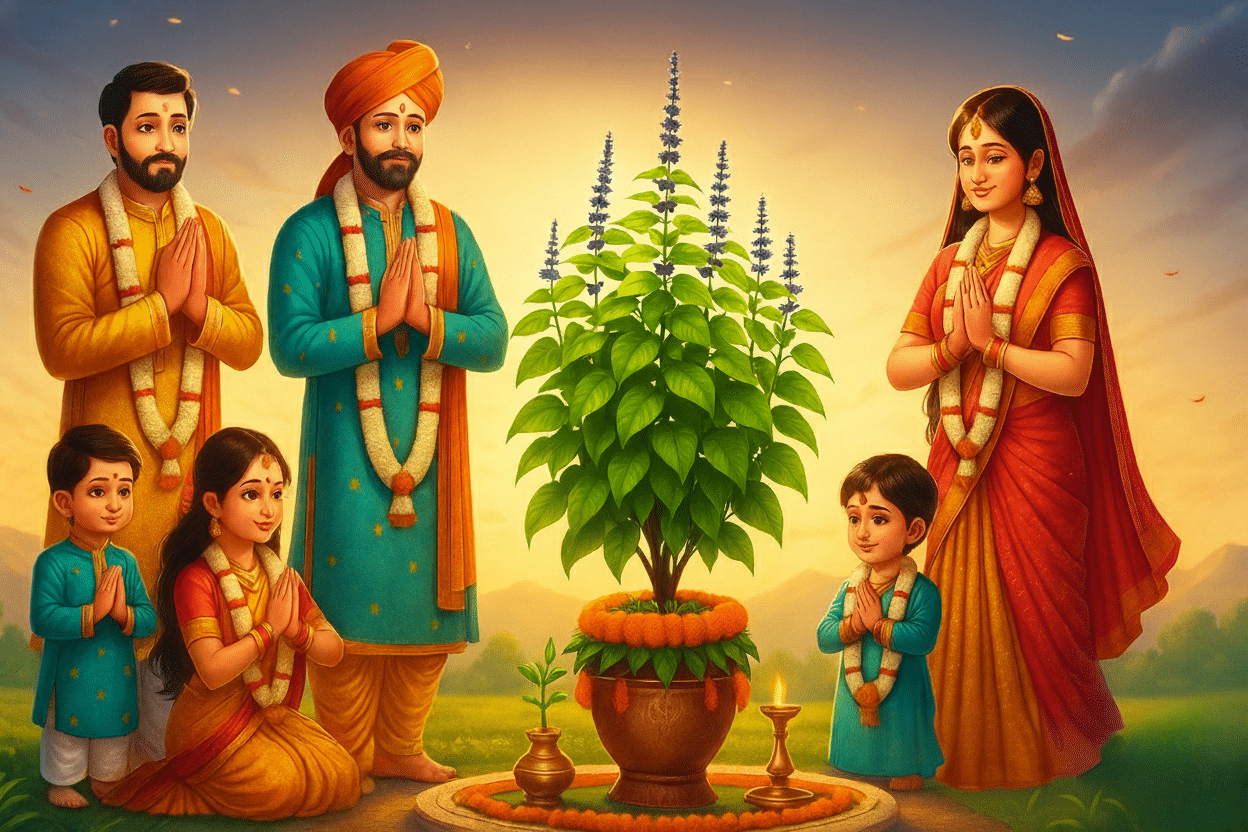
Tulasi Vivaha is the ceremonial marriage of the Tulasi plant to Lord Vishnu or Krishna. It usually occurs in Prabodhini Ekadashi (the 11th lunar day of Kartik month), marking the end of Chaturmas.
Why do we celebrate it? Because it honors Vrinda’s virtue and her eternal union with the divine. By performing this ritual, devotees reaffirm their own commitment to faith, purity, and spiritual alignment.
To celebrate Tulasi Vivaha at home, you can perform a simple ritual while keeping your focus on devotion and alignment.
Mantra for Tulasi Vivaha
ॐ तुलसीलक्ष्मी नमोऽस्तु नारायणाय।
सर्वसिद्धि प्रदायिन्यै नमः।
Om Tulasilakshmi Namo’stu Narayanaya
Sarvasiddhi Pradayinyai Namah
Meaning: This mantra honors Tulasi as the divine consort of Narayana (Vishnu) and seeks her blessings for success, harmony, and spiritual alignment in life.
Simple Steps for Tulasi Vivaha Pooja
Clean and Decorate: Wash the Tulasi plant and clean the surrounding area. Decorate it with flowers and a small cloth to symbolize bridal attire.
Place Lord Vishnu’s Symbol: Use a Shaligram, Krishna idol, or picture of Vishnu in front of the plant.
Offer Flowers and Incense: Present flowers, light incense sticks, and offer water or milk to the Tulasi plant.
Chant the Mantra: Recite the Tulasi Vivaha mantra 11 or 21 times, focusing on devotion and purity of heart. Then perform your regular Aarti.
Prasad Offering: Offer fruits, sweets, or other naivedya items to the Tulasi and Lord Vishnu. Share prasad with family and friends.
Meditate on the Story: Reflect on Vrinda’s devotion, Jalandhar’s challenge, and the spiritual lessons of Tulasi Vivaha.
These steps are simple but carry profound energy when done with sincerity. They invite spiritual blessings, harmony, and divine protection into your home.
Spiritual Lessons from Tulasi Vivaha
Tulasi Vivaha is not just a symbolic story. It carries deep spiritual lessons for everyday life.
Devotion is Power: Vrinda’s chastity was her shield. Your inner virtue and focus on dharma can protect you even against overwhelming challenges.
Power Needs Alignment: Jalandhar’s strength failed without Vrinda’s alignment. This teaches that material or worldly power alone is insufficient. Spiritual alignment is essential.
Faith Transcends Deception: Vrinda was deceived but remained devoted. Life may challenge your faith, but steadfastness elevates the soul.
Transformation Through Surrender: Vrinda’s transition to Tulasi shows that surrender to divine will can transform suffering into eternal grace.
Have you noticed how often life tests us through relationships, responsibilities, or even misfortune? Like Vrinda, we are offered the choice to remain aligned with virtue and dharma. When we do, blessings follow, sometimes in forms we cannot even imagine.
Tulasi in Daily Spiritual Life
Beyond the Vivaha ritual, Tulasi holds immense significance in daily life. Planting Tulasi in the home or worshipping it daily purifies the atmosphere, protects from negativity, and attracts divine grace. Tulasi is revered as a living goddess, a reminder of Vrinda’s unwavering devotion and eternal presence.
Many families perform Tulasi pooja every morning, offer water, flowers, and incense, and recite mantras to invite harmony, health, and prosperity. The story of Jalandhar and Vrinda makes these daily practices more than rituals they become acts of remembrance of virtue, alignment, and spiritual awakening.
Anecdote: Living the Lessons of Vrinda
I recall a devotee who struggled with personal and professional setbacks. She was often deceived by colleagues and faced repeated disappointments. One day, inspired by the story of Tulasi Vivaha, she planted a Tulasi in her home and began offering prayers every morning with sincerity. Within months, her perspective shifted. She became more disciplined, aligned, and mindful. Opportunities appeared, relationships improved, and her life transformed.
This is the living power of Tulasi, Vrinda, and devotion. It is not superstition—it is spiritual alignment in action.
Modern Significance of Tulasi Vivaha
Even today, Tulasi Vivaha reminds us that spiritual life and worldly life are intertwined. Rituals, devotion, and alignment with dharma help us navigate challenges while remaining rooted in virtue. The story of Jalandhar and Vrinda is a mirror for modern seekers:
Challenges will come.
External power alone is insufficient.
Virtue, devotion, and alignment with dharma are what sustain us.
Celebrating Tulasi Vivaha connects us to this timeless truth. It is a ritual that celebrates the eternal union of devotion and the divine, reminding us that even ordinary acts, like worshipping a plant, can carry immense spiritual significance.
Embracing the Spiritual Wisdom
Tulasi Vivaha is far more than a festival ritual. It is a story alive with cosmic lessons, dharmic principles, and spiritual truths.
Vrinda teaches us that devotion and chastity are forms of spiritual power. Jalandhar reminds us that external strength without inner alignment is fleeting. Tulasi Vivaha reminds us that surrender, virtue, and alignment with divine principles lead to eternal grace and prosperity.
This Kartik, as you celebrate Tulasi Vivaha, pause and reflect. Offer your prayers sincerely. Care for the Tulasi plant with devotion. Remember Vrinda’s story. Align your actions with dharma. Embrace challenges as teachers. Prepare for prosperity, not just materially, but spiritually.
By honoring Vrinda through Tulasi, we invite the eternal presence of the divine into our homes, hearts, and lives. And in that sacred act, the lessons of virtue, resilience, and devotion are eternally alive.
Therefore, seeking guidance from spiritual experts is imperative to get that unique mantra, meditation, and spiritual method crafted exclusively for you for the spiritual awakening you seek. And hence, we recommend you practice these interpretations and practices mentioned above under the guidance of an expert. Please subscribe to our mailing list to stay connected and receive spiritual information. In case of any queries, please write to us at info@chamundaswamiji.com.
You can check out our YouTube channel Chamunda Swamiji where you can learn Tantra, Mantra, Yantra, and Meditation from His Holiness Shri Chamunda Swamiji. If you seek to learn Shakti Kriya, please register with us, and we will get back to you.
Post a Comment
-
Subscribe to Our Blog
-
Categories
-
Popular Articles
- Orange butterfly: Spiritual Significance
- The Dasa Mahavidyas
- Maa Bhuvaneshwari | The Dasa Mahavidyas
- The Ghosts of Ganagapur Temple, Karnataka
- Vivah Bandhan Curse – What Is It and How to Spiritually Heal It.
- Tripura Sundari | The Dasa Mahavidya
- What are Beej Mantras?
- Decoding the Maha Mrityunjay Mantra: Origin, Meaning, and Benefits
- The Five Shades of Tantra
- 9 Most Powerful Tantric Temples in India