

- Email info@ChamundaSwamiJi.com
- Call +1-516-933-7590
-
 Email
info@ChamundaSwamiJi.com
Email
info@ChamundaSwamiJi.com
-
 Call
+1-516-933-7590
Call
+1-516-933-7590


Book an Appointment
Informative
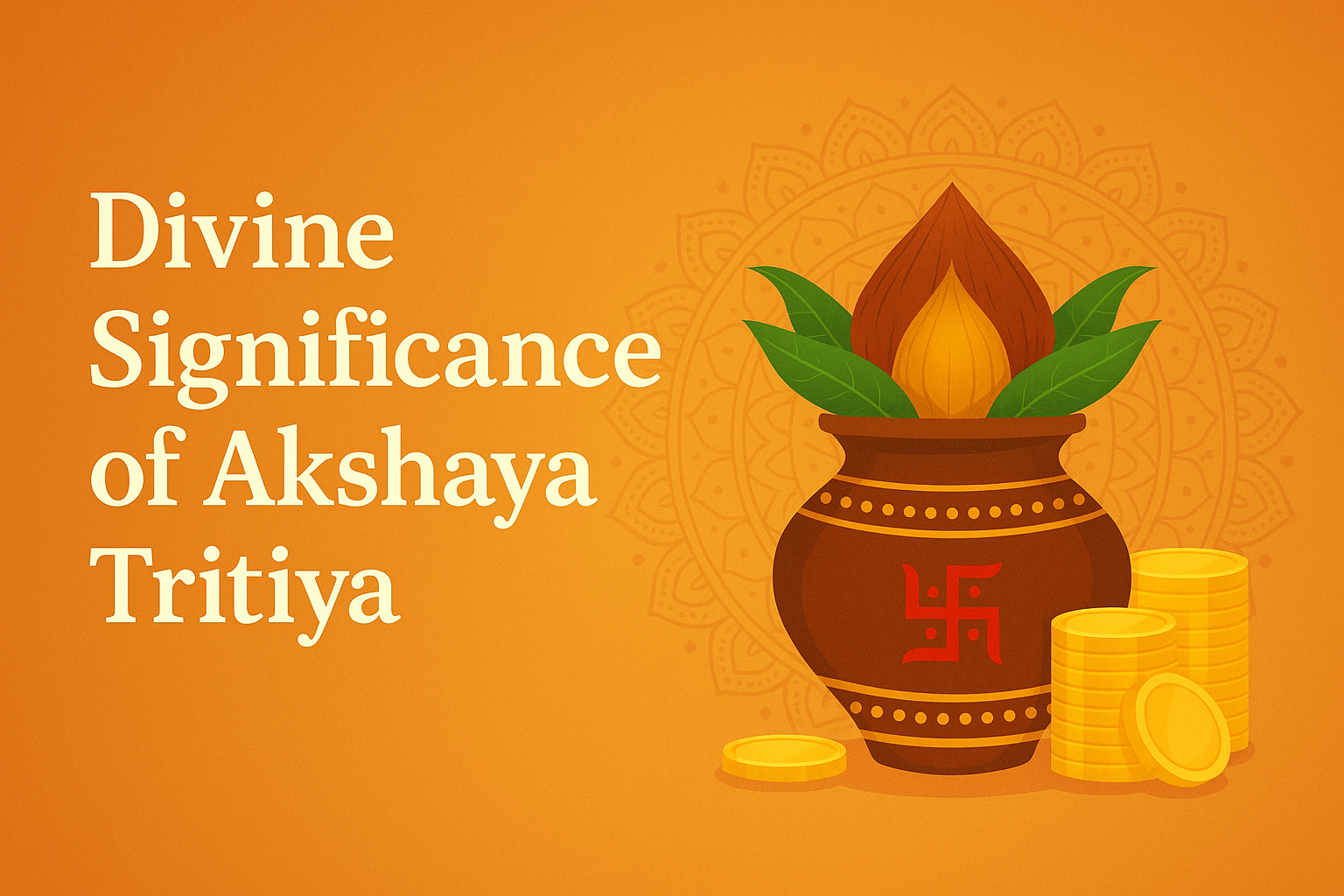
Divine Significance of Akshaya Tritiya: A Day of Eternal Prosperity
Akshaya Tritiya is not just a date in the Hindu calendar—it is a sacred cosmic junction where Karma, Dharma, and Purushartha align. Celebrated on the Tritiya Tithi, the third lunar day of the bright fortnight or Shukla Paksha of Vaishakha month, this day marks a powerful Mahurat—a time divinely coded for growth that is Akshaya, meaning “imperishable” or “everlasting”.
It is during this seasonal cusp—when spring matures into summer—that the cosmos breathes out new energy. According to the science of Kala Chakra, the Wheel of Time in Vedic philosophy, this period is infused with Sattva Guna, the quality of light, balance, and spiritual clarity, making it one of the most spiritually charged times of the year.
Why is it called Akshaya Tritiya?
The word Akshaya means that which is undecaying or inexhaustible. The term points toward the fruits of action, or Karma Phala, performed on this day, which are believed to remain forever in one’s Sanchita Karma—the storehouse of merits accumulated over lifetimes.
Tritiya Tithi is the third day of the waxing moon, Shukla Paksha, and on this day, cosmic energies are perfectly aligned for initiating auspicious deeds. Hence, the name Akshaya Tritiya, or colloquially in parts of India, Akha Teej.
The Day That Birthed the Yugas
According to Puranic lore and Jyotisha Shastra, Vedic astrology, all four cosmic cycles or Yugas—Satya Yuga, Treta Yuga, Dvapara Yuga, and Kali Yuga—began on this very day. It is called the Yugadi Tithi, the beginning of time in a spiritual sense. Therefore, any Satkarmas, or virtuous actions, done today bear fruits that transcend even the limitations of time.
Divine Incarnations and Avatars on Akshaya Tritiya
This sacred day also marks the descent, Avatarana, of multiple divine incarnations of Bhagwan Vishnu, the preserver of the universe:
Hayagriva Avatar: The form of Vishnu with a horse’s head, who restored the Vedas—the eternal knowledge—from the grasp of demons, Asuras.
Parashurama Avatar: The sixth incarnation of Vishnu, born to cleanse the world of adharma. Born under Punarvasu Nakshatra with exalted planets and Rahu in Gemini, his very Janma Kundli, or birth chart, shows deep Shakti, divine power. He wielded the Amodh Parashu—a celestial axe gifted by Lord Shiva after intense Tapasya, or penance.
Nara-Narayana Avatar: Symbolic of the ultimate balance of spiritual austerity and divine action.
Such divine descents reinforce the Tantric and Vedantic truth that divinity incarnates when Dharma is at stake.
The Eternal Principle: God is Akshaya
From the lens of Vedanta and Tantra, if Akshaya means eternal, then only the Paramatma, or Supreme Self—who is beyond birth, death, space, and time—can truly be Akshaya. This is Shiva, the ever-present, indivisible, and omniscient consciousness.
The Shiva Tattva exists in all of us, as the soul, or Atman. When we perform good deeds on this day—Daan, donation; Snan, ritual bath; Japa, mantra chanting; Tapa, austerity; Homa, fire rituals—we align ourselves with that eternal truth.
Opening of Badrinath and Cosmic Gateways
On this sacred day, the Kapat, or doors, of Badrinath Dham—the abode of Lord Vishnu in his meditative form—are opened. It signifies the awakening of spiritual energies in the North Direction, associated in Tantra with wisdom and higher consciousness.
Pilgrims travel to these holy places to invoke the grace of Vishnu through Seva, Puja, and Yagna, enhancing their soul’s Punya Bala, or strength of merit.
Darshan of Shri Bihari Ji in Vrindavan
In the mystical land of Vrindavan, the lotus feet of Shri Banke Bihari Ji are unveiled for rare public Darshan on Akshaya Tritiya. It is believed that even a glimpse on this day cleanses countless lifetimes of Karmic Vasanas, impressions of past actions.
Astrological Secrets of Akshaya Tritiya
From a Jyotishya standpoint, Akshaya Tritiya is one of the few days when the Sun, Surya—the Atma Karaka, indicator of the soul—is exalted in Mesha Rashi, Aries, and the Moon, Chandra, the mind, is in strength. This Rajayoga-like alignment means both our inner self and outer actions are illuminated.
When one takes a holy bath, Vaishakha Snan, under these celestial vibrations, it acts as a spiritual detox. In Tantra, water is a purifying element, ruled by the Moon, and ablutions on this day harmonize our Chakras, especially the Ajna, third-eye, and Anahata, heart center, making meditation more powerful.
Regional Rituals and Auspicious Beginnings
In many parts of India, this day is associated with agricultural rituals and rain predictions. In Rajasthan, traditional omens, Shakun Shastra, are read, kites are flown symbolizing hope, and Satnaja, seven grains, are ritually worshipped, invoking fertility and abundance.
Across Bharat, Akshaya Tritiya is the favored day to:
Buy gold and silver, symbolizing Lakshmi-Tattva, the essence of wealth and prosperity
Begin new ventures or business, Shubh Arambh
Lay the foundation of homes or temples
Perform housewarmings, Griha Pravesh
Start spiritual journeys like Upanayana, Puja Vidya, or even Sadhana Deeksha in Tantric lineages
This day carries a Swatantra Mahurat—a self-sufficient auspicious time, free of the need for a pandit to calculate a muhurta.
For the Sadhaka, spiritual seeker, Akshaya Tritiya is not just a day on the calendar; it is a sacred portal that opens the door to infinite Shakti, divine energy, Jnana, wisdom, and Punya, spiritual merit. Actions taken today multiply across lifetimes. It is a divine opportunity to cleanse your karma, start new chapters, and walk the eternal path of Sanatana Dharma with faith and purity.
May this Akshaya Tritiya bless you with unending prosperity, health, wisdom, and liberation.
Post a Comment
-
Subscribe to Our Blog
-
Categories
-
Popular Articles
- Dead moth in the house. What universe is trying to tell you?
- Spiritual Meaning of Moth
- The Dasa Mahavidyas
- Orange butterfly: Spiritual Significance
- Vivah Bandhan Curse – What Is It and How to Spiritually Heal It.
- Maa Bhuvaneshwari | The Dasa Mahavidyas
- Tripura Sundari | The Dasa Mahavidya
- What are Beej Mantras?
- The Ghosts of Ganagapur Temple, Karnataka
- Spiritual Meaning of Ant in Your Home.