

- Email info@ChamundaSwamiJi.com
- Call +1-516-933-7590
-
 Email
info@ChamundaSwamiJi.com
Email
info@ChamundaSwamiJi.com
-
 Call
+1-516-933-7590
Call
+1-516-933-7590


Book an Appointment
Informative
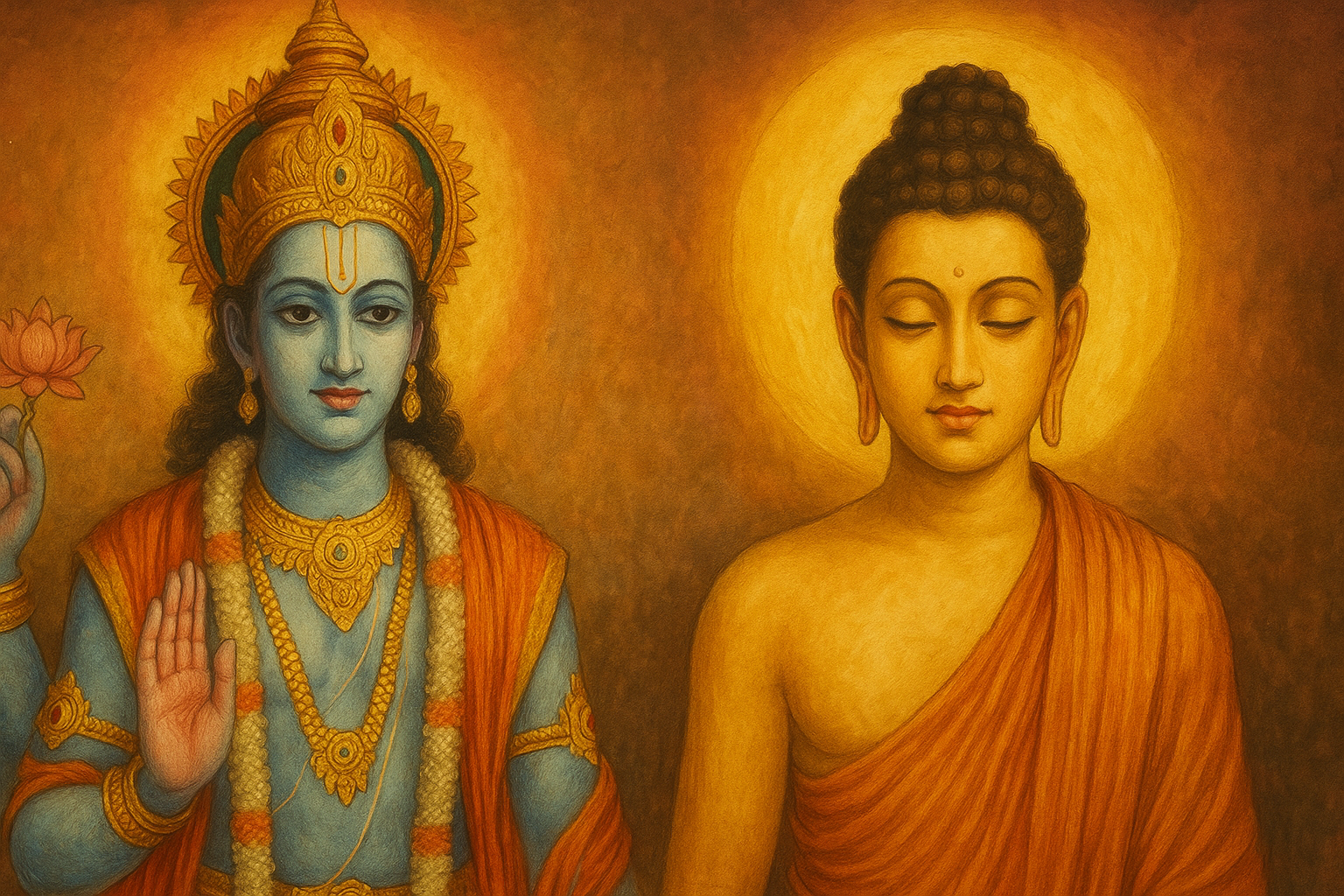
Lord Buddha as the Ninth Incarnation of Vishnu – A Divine Path to Peace and Inner Liberation
The ten incarnations of Lord Vishnu, known as the Dashavatara, are described in the ancient scriptures across the four Yugas Satyayug, Tretayug, Dwaparayug, and Kaliyug. These incarnations were not just mythological forms, but divine interventions designed to restore Dharma and guide humanity back to spiritual truth.
In this sacred sequence, Lord Buddha is revered as the ninth incarnation of Vishnu, specifically in Kaliyug the age of spiritual decline and material confusion. His role was unique: unlike other incarnations who came with weapons, Buddha came armed with silence, wisdom, and compassion.
Puranic Recognition of Buddha as Vishnu’s Incarnation
The Garuda Purana and Agni Purana both mention Buddha among Vishnu’s ten incarnations. According to these Puranas, Buddha incarnated in Keekat Desh, a land later known as Magadha, the region of modern-day Bodh Gaya, where he attained enlightenment.
The Shrimad Bhagavatam too proclaims that as Kaliyug begins, Lord Vishnu will take birth as the son of Anjana, and his name shall be Buddha. The Narasimha Purana explains that Buddha will guide those who were performing animal sacrifices and violent rituals in the name of Dharma, toward a path of Ahimsa—non-violence.
Even the Ramayana references Buddha sixteen times, including once in the Ayodhya Kanda, showing that this incarnation was deeply rooted in Sanatan consciousness.
The Spiritual Purpose of Buddha’s Incarnation
Mahatma Gautam Buddha was born on the full moon day of the month of Vaishakh. His mission was profound: to rescue people from ritualistic rigidity and redirect them inward. At a time when spiritual practices were losing their essence and becoming mere formalities, Buddha emerged to reintroduce inner purity, self-inquiry, and peace.
He advocated the Middle Path a balance between self-indulgence and extreme renunciation. His message was simple yet transformative: suffering exists because of desire, and freedom from desire leads to Nirvana.
Buddha’s Wisdom: From Desire to Liberation
Buddha taught that the mind, when entangled in greed and longing, binds the soul to the cycle of rebirth. He emphasized that by mastering thoughts and remaining rooted in the present moment, one can rise above both pain and pleasure.
He categorized the path to liberation into three core disciplines:
Shila – Ethical Conduct
Samadhi – Deep Meditation
Prajna – Supreme Wisdom
These were further expanded into the well-known Ashtanga Marg, or the Eightfold Path, which is a yogic and ethical map for both inner freedom and outer harmony.
The Eightfold Path: The Road to Nirvana
Right Viewpoint – Understanding the truth of life and suffering
Right Resolve – Setting pure and dharmic intentions
Right Speech – Speaking truthfully and compassionately
Right Action – Acting in ways that cause no harm
Right Livelihood – Earning by righteous means
Right Effort – Persisting in the purification of the mind
Right Memory – Developing constant awareness
Right Concentration – Cultivating deep meditative focus
Through these, Buddha revealed a life rooted in sattva purity and balance leading to Nirvana, a state beyond suffering and rebirth.
Enlightenment Under the Bodhi Tree
After intense meditation for 49 days under a fig tree, Gautam Buddha attained enlightenment. That tree came to be known as the Bodhi Tree. It symbolizes spiritual awakening, inner silence, and the blossoming of divine wisdom. His state of realization was not borrowed from scriptures it was direct experience of universal truth.
Vedic Roots and Shankaracharya’s View
Though Lord Buddha’s path seemed different from Vedic traditions, he had studied the Vedas and Upanishads deeply. What he rejected was not the Veda itself, but the misuse of rituals that had lost their inner spirit.
Adi Shankaracharya, the great proponent of Advaita Vedanta, did not accept Buddha as an incarnation of Vishnu in his writings. He critiqued some of Buddha’s anti-Vedic positions but also respected his emphasis on morality, inner silence, and detachment.
This dual view reflects the richness of Indian thought, where even disagreements hold space for mutual reverence.
Buddha’s Legacy in Sanatan Dharma
For followers of Sanatan Dharma, Buddha is not seen in opposition but as a unique embodiment of Vishnu’s compassion. In a time when religion was becoming mechanical, he brought back the essence—dharma without violence, meditation without ego, and liberation without dogma.
He didn’t destroy dharma he purified it.
The Silent Avatar Who Spoke to the Soul
Lord Buddha came not to argue but to awaken. He was the voice of inner simplicity amidst external chaos. As the ninth avatar of Vishnu, he brought the light of wisdom where darkness had crept in the name of religion.
Today, more than ever, his message remains relevant. In a world chasing noise, Buddha teaches silence. In a world divided by belief, he teaches compassion. In a world burning with desire, he teaches balance.
Even though plenty of literature is available on spiritual practices, it is highly recommended that one learn these methods under the supervision of a Guru or an expert. Everyone has unique spirituality, personality, and experiences. One solution cannot fit all. Therefore, seeking guidance from spiritual experts is imperative to get that unique mantra, meditation, and spiritual method crafted exclusively for you for the spiritual awakening you seek. And hence, we recommend you practice these interpretations and practices mentioned above under the guidance of an expert.
Please subscribe to our mailing list to stay connected and receive spiritual information. In case of any queries, please write to us at info@chamundaswamiji.com. You can check out our YouTube channel Chamunda Swamiji where you can learn Tantra, Mantra, Yantra, and Meditation from His Holiness Shri Chamunda Swamiji. If you seek to learn Shakti Kriya, please register with us, and we will get back to you.
Post a Comment
-
Subscribe to Our Blog
-
Categories
-
Popular Articles
- Dead moth in the house. What universe is trying to tell you?
- Spiritual Meaning of Moth
- The Dasa Mahavidyas
- Orange butterfly: Spiritual Significance
- Vivah Bandhan Curse – What Is It and How to Spiritually Heal It.
- Maa Bhuvaneshwari | The Dasa Mahavidyas
- Tripura Sundari | The Dasa Mahavidya
- What are Beej Mantras?
- The Ghosts of Ganagapur Temple, Karnataka
- Spiritual Meaning of Ant in Your Home.