

- Email info@ChamundaSwamiJi.com
- Call +1-516-933-7590
-
 Email
info@ChamundaSwamiJi.com
Email
info@ChamundaSwamiJi.com
-
 Call
+1-516-933-7590
Call
+1-516-933-7590


Book an Appointment
Informative
Chaitra Navratri Puja Vidhi at Home: Step-by-Step Guide
Every year when Chaitra Navratri approaches, devotion naturally increases. Homes are cleaned, temples become active, and many devotees feel a sincere desire to worship Maa Durga with discipline and respect. Yet a quiet doubt often remains in the mind.
Am I performing the Navratri puja vidhi correctly?
Many people feel that traditional rituals are too complicated or that they might miss something important. Others simply want a clear and practical way to follow the puja at home without confusion. The purpose of a structured Chaitra Navratri puja vidhi is not to burden the devotee but to bring rhythm and focus to these sacred nine days.
Navratri is ultimately about awakening inner strength and clarity. When the rituals are done with sincerity, even a simple daily puja becomes powerful spiritual practice.
Preparing the Home for Navratri Puja
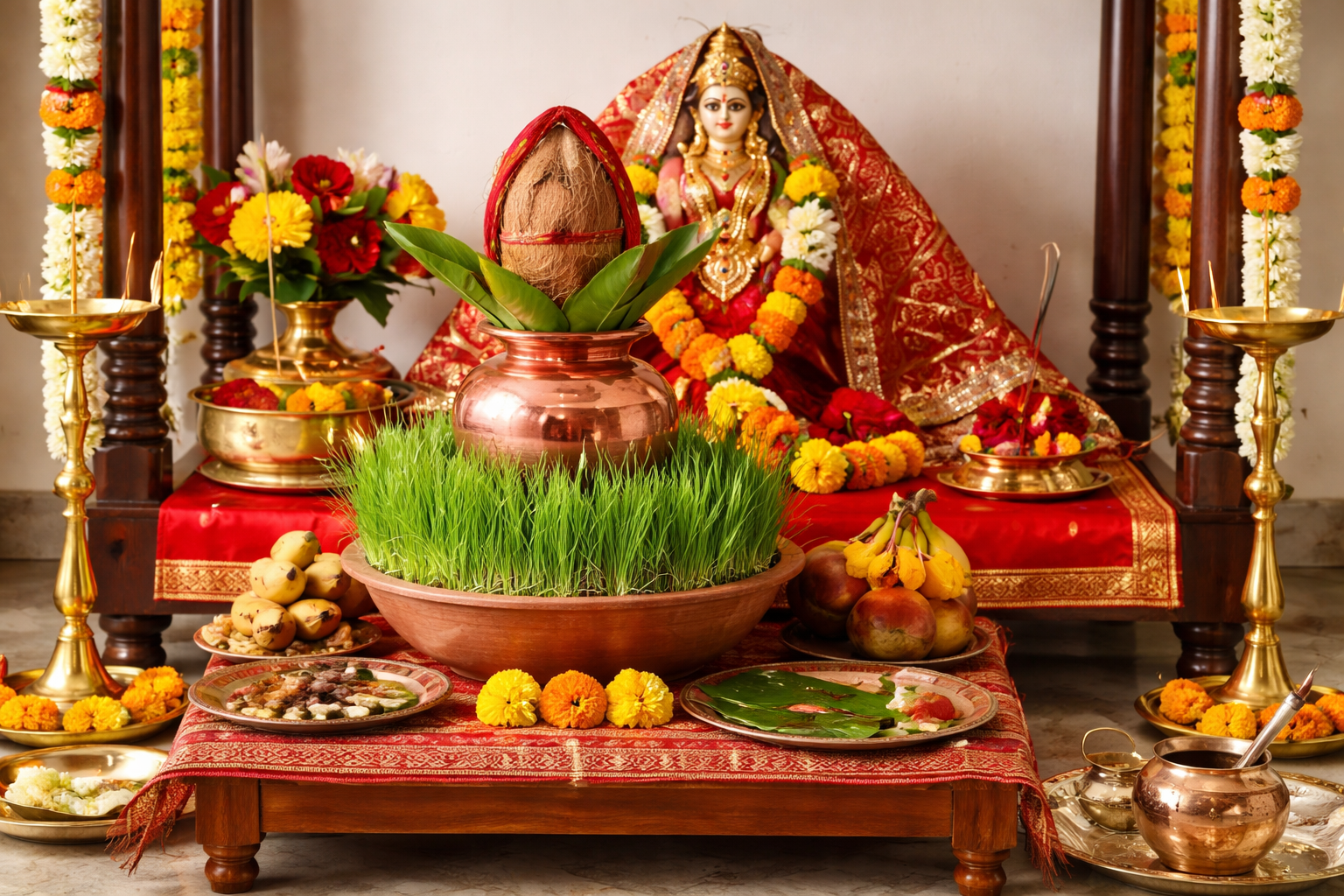
The first step in the Navratri puja vidhi begins with preparing the sacred space. Clean the home temple or the area where you will perform the puja. Place a clean red or yellow cloth on the altar and install an image or idol of Maa Durga.
On the first day, devotees perform Ghatasthapana (Kalash Sthapana). A copper or clay pot filled with water is placed on rice or soil. Mango leaves and a coconut are placed on the kalash. This kalash represents divine Shakti present in the home during Navratri.
Light a diya and incense daily in front of the Goddess. Offer flowers, kumkum, and fruits as bhog. After the offerings, chant mantras, meditate, and perform aarti. This simple structure forms the daily Navratri puja vidhi that continues throughout the nine days.
Navratri Day-Wise Puja, Beej Mantra, and Durga Saptashati Reading
During Chaitra Navratri puja vidhi, each day is dedicated to a specific form of Maa Durga. Along with daily worship, devotees chant the beej mantra of that Goddess and read selected chapters from Durga Saptashati. After completing the puja, sit quietly and chant the mantra for at least 21 minutes, allowing the mind to focus completely on the energy of that Devi.
Day 1 – Maa Shailputri
Beej Mantra
ॐ देवी शैलपुत्र्यै नमः
Om Devi Shailputryai Namah
Offer pure ghee as bhog and pray for stability and grounding. Maa Shailputri represents the beginning of the spiritual journey. After the puja, sit in meditation and chant her mantra for 21 minutes, focusing on grounding your mind and intentions for the nine days.
Durga Saptashati Reading
Chapter 1 – Madhu Kaitabha Vadha
(The Slaying of the Demons Madhu and Kaitabha)
Day 2 – Maa Brahmacharini
Beej Mantra
ॐ देवी ब्रह्मचारिण्यै नमः
Om Devi Brahmacharinyai Namah
Offer sugar or mishri as bhog and pray for discipline and devotion. Maa Brahmacharini symbolizes tapas and spiritual determination. Chant her mantra for 21 minutes, allowing the mind to become steady and focused.
Durga Saptashati Reading
Chapter 2 – Mahishasura Sainya Vadha
(The Slaying of the Armies of Mahishasura)
Chapter 3 – Mahishasura Vadha
(The Slaying of the Demon Mahishasura)
Day 3 – Maa Chandraghanta
Beej Mantra
ॐ देवी चन्द्रघण्टायै नमः
Om Devi Chandraghantayai Namah
Offer milk or kheer as bhog. Maa Chandraghanta represents courage and protection. Sit quietly and chant her mantra for 21 minutes, visualizing divine protection around you.
Durga Saptashati Reading
Chapter 4 – Devi Stuti by the Gods
(Praise of the Goddess after the defeat of Mahishasura)
Day 4 – Maa Kushmanda
Beej Mantra
ॐ देवी कूष्माण्डायै नमः
Om Devi Kushmandayai Namah
Offer malpua or sweet dishes as bhog. Maa Kushmanda represents cosmic creation and vitality. Chant her mantra for 21 minutes, focusing on inner energy and clarity.
Durga Saptashati Reading
Chapter 5 – Devi Doota Samvada
(The Conversation between the Goddess and the Demon’s Messenger)
Chapter 6 – Dhumralochana Vadha
(The Slaying of the Demon Dhumralochana)
Day 5 – Maa Skandamata
Beej Mantra
ॐ देवी स्कन्दमातायै नमः
Om Devi Skandamatayai Namah
Offer bananas as bhog. Maa Skandamata represents nurturing energy and compassion. Chant her mantra for 21 minutes, focusing attention on the heart center.
Durga Saptashati Reading
Chapter 7 – Chanda Munda Vadha
(The Slaying of the Demons Chanda and Munda)
Chapter 8 – Raktabeeja Vadha
(The Slaying of the Demon Raktabeeja)
Day 6 – Maa Katyayani
Beej Mantra
ॐ देवी कात्यायन्यै नमः
Om Devi Katyayanyai Namah
Offer honey as bhog and pray for courage and justice. Chant her mantra for 21 minutes, strengthening determination and removing obstacles.
Durga Saptashati Reading
Chapter 9 – Nishumbha Vadha
(The Slaying of the Demon Nishumbha)
Day 7 – Maa Kalaratri
Beej Mantra
ॐ देवी कालरात्र्यै नमः
Om Devi Kalaratryai Namah
Offer jaggery as bhog. Maa Kalaratri represents the destruction of darkness and fear. Sit quietly and chant the mantra for 21 minutes, allowing the mind to release negativity.
Durga Saptashati Reading
Chapter 10 – Shumbha Vadha
(The Slaying of the Demon Shumbha)
Chapter 11 – Narayanī Stuti
(The Praise of the Goddess by the Devas)
Day 8 – Maa Mahagauri
Beej Mantra
ॐ देवी महागौर्यै नमः
Om Devi Mahagauryai Namah
Offer coconut or coconut sweets as bhog. Maa Mahagauri symbolizes purification and peace. Chant her mantra for 21 minutes, focusing on calmness and clarity.
Durga Saptashati Reading
Chapter 12 – Phalashruti
(The Fruits and Benefits of Reciting the Devi Mahatmya)
Day 9 – Maa Siddhidatri
Beej Mantra
ॐ देवी सिद्धिदात्र्यै नमः
Om Devi Siddhidatryai Namah
Offer sesame sweets or halwa as bhog. Maa Siddhidatri grants spiritual accomplishments and blessings. Chant the mantra for 21 minutes, expressing gratitude for the nine days of worship.
Durga Saptashati Reading
Chapter 13 – Suratha and Samadhi Attain the Blessings of the Goddess
Daily Mantra Meditation Practice During Navratri
Beyond the ritual aspects of the Navratri puja vidhi, mantra meditation is considered one of the most powerful practices during Navratri. After completing the daily puja, sit comfortably in front of the altar and close your eyes. Chant the mantra of the Goddess being worshipped that day for at least 21 minutes.
The chanting should be steady and rhythmic, either aloud or mentally. Focus your attention on the sound vibration of the mantra and the presence of the Goddess. Over the nine days, this daily practice gradually calms the mind and strengthens spiritual awareness.
Combining mantra chanting with Durga Saptashati reading and Navratri day-wise puja creates a complete spiritual discipline during Chaitra Navratri.
Keeping Navratri Spirit Alive at Home
The purpose of the Navratri puja vidhi is not only ritual performance but inner transformation. These nine days invite the devotee to cultivate discipline, devotion, and self-awareness.
Following the Chaitra Navratri puja vidhi, practicing Navratri day-wise puja, offering Navratri bhog for each day, and chanting the beej mantras for meditation allows the home to become a sacred space of spiritual practice.
When performed with sincerity, these nine days of worship gradually awaken the inner strength that Maa Durga represents. Navratri then becomes more than a festival. It becomes a journey of devotion, reflection, and transformation.
Even though plenty of literature is available on spiritual practices, it is highly recommended that one learn these methods under the supervision of a Guru or an expert. Everyone has unique spirituality, personality, and experiences. One solution cannot fit all.
Therefore, seeking guidance from spiritual experts is imperative to get that unique mantra, meditation, and spiritual method crafted exclusively for you for the spiritual awakening you seek. And hence, we recommend you practice these interpretations and practices mentioned above under the guidance of an expert. Please subscribe to our mailing list to stay connected and receive spiritual information. In case of any queries, please write to us at info@chamundaswamiji.com.
You can check out our YouTube channel Chamunda Swamiji where you can learn Tantra, Mantra, Yantra, and Meditation from His Holiness Shri Chamunda Swamiji. If you seek to learn Shakti Kriya, please register with us, and we will get back to you.
Blessings from His Holiness Shri Chamunda Swami Ji.
Post a Comment
-
Subscribe to Our Blog
-
Categories
-
Popular Articles
- Orange butterfly: Spiritual Significance
- The Dasa Mahavidyas
- Maa Bhuvaneshwari | The Dasa Mahavidyas
- The Ghosts of Ganagapur Temple, Karnataka
- Vivah Bandhan Curse – What Is It and How to Spiritually Heal It.
- Tripura Sundari | The Dasa Mahavidya
- What are Beej Mantras?
- Decoding the Maha Mrityunjay Mantra: Origin, Meaning, and Benefits
- The Five Shades of Tantra
- 9 Most Powerful Tantric Temples in India