

- Email info@ChamundaSwamiJi.com
- Call +1-516-933-7590
-
 Email
info@ChamundaSwamiJi.com
Email
info@ChamundaSwamiJi.com
-
 Call
+1-516-933-7590
Call
+1-516-933-7590


Book an Appointment
Informative
How Hanuman Bhakti Awakens Inner Power
Lord Hanuman is often revered as the deity of Prana the vital life force that sustains the body, mind, and consciousness. Scriptures describe him as Pavanputra, the Son of the Wind. In Yogic understanding, “Pavan” is not merely physical air. It symbolizes the movement of Prana, the subtle force that animates life itself.
Prana is the energy that keeps the mind active, empowers the emotions, strengthens the body, and maintains the connection between consciousness and the physical form. When this Prana weakens, a person begins to feel internally exhausted. Fear, confusion, lethargy, hopelessness, and emotional instability gradually take over.
When Prana becomes awakened and balanced, a different transformation begins. Courage starts arising naturally. The mind becomes stable. A sense of inner protection develops, even in difficult circumstances. This is one of the deepest spiritual dimensions associated with Lord Hanuman.
Hanuman Beyond Mythology
For most people, Hanuman immediately represents strength, courage, devotion, and protection. Yet from the perspective of Yoga and Tantra, Hanuman is far more than a mythological deity. He represents awakened Prana Shakti in its purest form.
The human body is not limited to flesh and bones. Within it exists a subtle energy system composed of Nadis (energy channels), Chakras (energy centers), breath currents, and consciousness. Spiritual traditions have long held that sincere devotion has the ability to influence and purify this inner system.
Hanuman Bhakti works directly upon this energetic structure. Over time, the practitioner begins experiencing shifts in breath, emotions, mental stability, and inner resilience. What begins as devotion slowly evolves into an energetic transformation.
Bhakti as a Science of Energy
Many people consider devotion to be purely emotional. In reality, Bhakti functions as a subtle science of consciousness and energy.
When a person repeatedly chants “Ram,” “Hanuman,” or specific Hanuman mantras with sincerity, the rhythm of the breath starts changing. As the breath changes, the flow of Prana changes. When Prana changes, the nervous system responds. Eventually, the state of the mind itself transforms.
This is why genuine spiritual practitioners often radiate calmness and inner strength. Their energy system gradually becomes more balanced and steady through devotion.
Hanuman devotion particularly strengthens courage, emotional stability, discipline, and energetic resilience. These changes are not merely psychological. Yogic traditions view them as direct effects of Pranic purification.
Hanuman Devotion and the Muladhara Chakra
Fear, insecurity, survival anxiety, and instability are deeply connected with the Muladhara Chakra, the root energy center. Hanuman worship is traditionally associated with strengthening this foundation.
As devotion deepens, many practitioners begin to feel emotionally grounded. Their reactions become calmer. Inner panic reduces. A subtle feeling of support begins arising from within.
This explains why people instinctively turn toward the Hanuman Chalisa during periods of crisis. In moments of fear, the mind does not seek philosophy alone. It seeks energetic stability.
When Bhakti matures beyond ritual, the individual slowly transforms internally. Speech changes. Emotional responses become more disciplined. Perspective becomes clearer. The person starts living with greater awareness and strength.
At this stage, devotion stops being merely religious practice. It becomes Urja Sadhana a discipline of transforming consciousness through energy.
Experiences During Hanuman Sadhana
During Hanuman Sadhana, some individuals report sensations such as trembling, heat, emotional release, tears, chest pressure, or sudden calmness. Yogic traditions associate these experiences with intensified Pranic movement within the body.
As dormant energy begins moving through the subtle channels, the body and mind may react in different ways. However, every intense sensation should not automatically be considered spiritual.
Sometimes such experiences may arise from emotional release, psychological conditions, or nervous system responses. Spiritual maturity requires balance, grounding, and discernment.
If a person becomes calmer, mentally clearer, emotionally stronger, and more disciplined through practice, these are traditionally considered healthier signs of Pranic awakening.
The Yogic Meaning of Hanuman’s Form
Hanuman’s physical form carries deep symbolic meaning within Yogic and Tantric traditions.
The Mystery of the Vanara Form
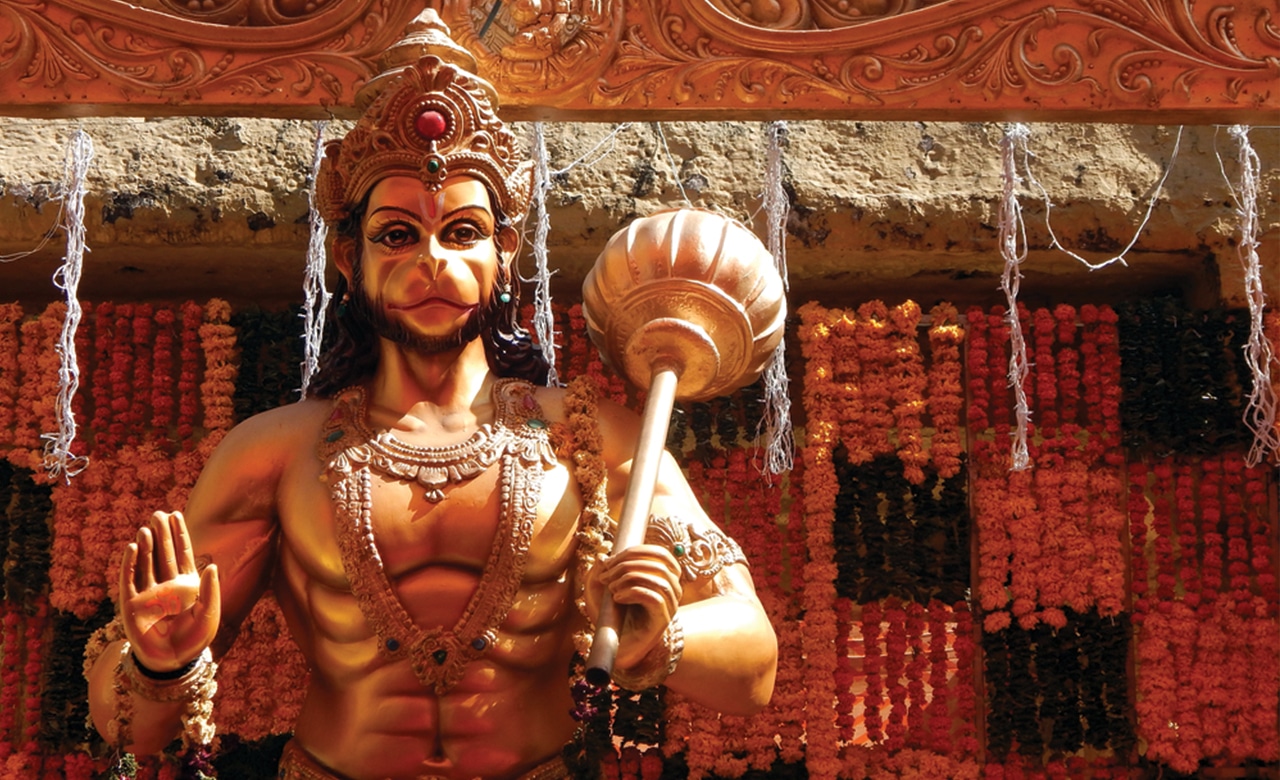
The Vanara or monkey form symbolizes the restless human mind. The mind naturally jumps from one thought to another. It remains unstable, reactive, and distracted.
In Hanuman, this restless force becomes disciplined and completely surrendered to the Divine. The same mind that creates confusion transforms into a vehicle of spiritual power when anchored in higher consciousness.
The Meaning of Hanuman’s Strength
Hanuman’s immense strength was never viewed as muscular power alone. Yogic traditions connect his power to disciplined Prana, Brahmacharya, Tapas, and mental steadiness.
Wherever Prana becomes stable, extraordinary endurance and vitality begin manifesting within the body and mind. This is why Hanuman is regarded as the living expression of controlled life-force energy.
The Symbolism of the Gada
Hanuman’s Gada or mace represents more than a weapon. Spiritually, it symbolizes willpower, disciplined energy, and mastery over lower impulses.
It represents the ability to direct one’s energy consciously rather than becoming controlled by desires, fear, or emotional instability.
Hanuman’s Ability to Expand and Contract
Hanuman is described as assuming gigantic forms at one moment and becoming extremely small at another. Yogically, this symbolizes mastery over consciousness and Prana.
In spiritual science, such powers are linked with Mahima and Laghima Siddhis states connected to expansion and contraction of consciousness.
Hanuman and the Five Pranas
Yoga describes five primary Pranic forces within the body:
Prana
Apana
Samana
Udana
Vyana
Hanuman is considered the embodiment of balance among all five.
His connection is especially associated with Udana Vayu and Vyana Vayu. Udana governs upward-moving energy linked with consciousness, speech, and spiritual ascent. Vyana governs the circulation of energy throughout the body.
This balance explains why Hanuman is portrayed with immense strength, extraordinary awareness, unwavering focus, and complete mental control.
Hanuman and Chakra Awakening
Muladhara Chakra: Hanuman’s fearlessness and stability reflect the awakening of the root chakra. This strengthens grounding, courage, and survival energy.
Manipura Chakra: His fiery energy, determination, and heroism reflect an awakened Manipura Chakra. This energy center governs confidence, action, willpower, and transformation.
Anahata Chakra: Despite possessing immense strength, Hanuman’s greatest quality is devotion and love for Lord Rama. This reflects the purity of the Anahata Chakra or heart center.
Power and compassion coexist harmoniously within him.
Ajna Chakra: Hanuman’s mind remains unwavering even in extreme situations. He never loses clarity, courage, or focus. This stability represents mastery over the Ajna Chakra, associated with perception and inner vision.
Hanuman and the Nadis
Yogic science describes three primary Nadis:
Ida
Pingala
Sushumna
Hanuman is especially associated with balanced Pingala energy and the awakening of Sushumna. Pingala represents solar force, action, vitality, and dynamic energy.
Despite possessing enormous power, Hanuman remains free from ego. This balance between energy and humility is one of the deepest spiritual lessons within Hanuman Sadhana.
The Spiritual Connection Between Ram and Hanuman
Hanuman’s entire consciousness remained absorbed in “Ram.” Spiritually, the sound vibration of “Ram” is believed to stabilize both the heart and Prana.
Hanuman represents the living embodiment of this sacred vibration. This is why many traditions believe that chanting “Ram” gradually calms the mind and harmonizes the inner energy system.
For many practitioners, devotion to Hanuman naturally deepens devotion toward Rama consciousness.
Effects of Hanuman Sadhana on Body and Mind
On the physical level, Hanuman Sadhana is believed to increase vitality, improve breath stability, reduce lethargy, and strengthen mental endurance.
On the subtle level, fear gradually weakens. Negative thought patterns begin losing intensity. Emotional resilience increases. Many practitioners report experiencing a stronger sense of inner security and protection.
These effects are closely connected with the stabilization of Prana.
Hanuman and Brahmacharya
Brahmacharya forms a central aspect of Hanuman’s spiritual power. In Yogic understanding, Brahmacharya extends far beyond physical celibacy.
It represents conservation of life-force energy, discipline of the senses, mastery over impulses, and conscious direction of awareness. Through this conservation of Prana, spiritual radiance or Tejas becomes stronger.
Hanuman is therefore seen as a symbol of restrained yet immensely powerful energy.
Hanuman in Yoga, Tantra, and Spiritual Science
Different spiritual traditions understand Hanuman in different ways.
In Bhakti traditions, he is the supreme devotee of Rama. In Yoga, he represents awakened Prana Shakti. In Tantra, he is viewed as protective spiritual force. In Vedanta, he symbolizes egoless consciousness.
For spiritual practitioners, Hanuman ultimately represents the dormant divine energy hidden within every human being.
The Inner Awakening Through Hanuman Sadhana
Many spiritual teachers describe Hanuman as an inner force rather than an external power. When a practitioner combines Ram Naam, Pranayama, and Hanuman contemplation, gradual changes begin unfolding within.
The breath becomes steady. The mind becomes quieter. Emotional fear reduces. Inner strength starts emerging naturally.
This is why saints often say:
“Hanuman is not merely a deity outside you. He is the awakened Prana within you.”
Hanuman devotion therefore becomes much more than worship. It becomes a process of inner purification, energetic stabilization, and spiritual awakening. Through Bhakti, the practitioner slowly transforms fear into courage, weakness into discipline, and scattered energy into conscious power.
Even though plenty of literature is available on spiritual practices, it is highly recommended that one learn these methods under the supervision of a Guru or an expert. Everyone has unique spirituality, personality, and experiences. One solution cannot fit all.
Therefore, seeking guidance from spiritual experts is imperative to get that unique mantra, meditation, and spiritual method crafted exclusively for you for the spiritual awakening you seek. And hence, we recommend you practice these interpretations and practices mentioned above under the guidance of an expert. Please subscribe to our mailing list to stay connected and receive spiritual information. In case of any queries, please write to us at info@chamundaswamiji.com.
You can check out our YouTube channel Chamunda Swamiji where you can learn Tantra, Mantra, Yantra, and Meditation from His Holiness Shri Chamunda Swamiji. If you seek to learn Shakti Kriya, please register with us, and we will get back to you.
Post a Comment
-
Subscribe to Our Blog
-
Categories
-
Popular Articles
- Orange butterfly: Spiritual Significance
- The Dasa Mahavidyas
- Maa Bhuvaneshwari | The Dasa Mahavidyas
- Vivah Bandhan Curse – What Is It and How to Spiritually Heal It.
- The Ghosts of Ganagapur Temple, Karnataka
- Tripura Sundari | The Dasa Mahavidya
- What are Beej Mantras?
- Decoding the Maha Mrityunjay Mantra: Origin, Meaning, and Benefits
- The Five Shades of Tantra
- Bangles – A Forgotten Tradition – Their Spiritual and Health Benefits